Client overview
A leading international hotel group partnered with Global Swiss Learning (GSL) to pilot a self-guided Breakfast Chef Training program at one of their flagship properties in the UK. The pilot was designed to strengthen breakfast operations, support ongoing professional chef development among experienced culinary professionals, and evaluate the effectiveness of flexible digital learning within a hotel environment.
Supported by both corporate and property leadership, the pilot was completed over a four-week learning period. Despite the short timeframe and high experience-level of the chefs, the participants demonstrated measurable improvements in knowledge, confidence, and workplace application, helping validate the effectiveness of a specialized breakfast-focused development pathway as a part of professional chef training.
Key takeaways
👉 Delivered measurable learning outcomes in just four weeks
👉 Achieved a 9-point increase in assessment scores
👉 Reached a 95% average final assesment score
👉 Delivered measurable gains among experienced chefs
👉 Achieved a 100% recommendation rate
👉 Achieved 100% reported workplace application of learning
👉 Increased confidence across all measured competency areas
👉 Demonstrated strong potential for scalable implementation across hotel operations
The challenge
Breakfast is one of the most visible and operationally important service periods within any hotel. Consistent execution requires strong technical skills, operational discipline, food safety knowledge, presentation standards, and guest-focused service.
The organization wanted to explore whether a self-guided learning approach could:
🟣 Strengthen breakfast-specific culinary knowledge
🟣 Build professional chef competencies
🟣 Support continuing professional and leadership development for culinary teams
🟣 Create a scalable learning model for future implementation
🟣 Improve confidence across key breakfast competencies
🟣 Deliver measurable learning outcomes through assessment and certification
Unlike many training programs aimed at entry-level employees, this pilot focused on experienced hospitality professionals already working in leadership-oriented kitchen roles.
The learners
The pilot cohort consisted of experienced culinary professionals working within hotel operations.
Learner snapshot
✅ Held Sous Chef positions
✅ Had more than seven years of professional kitchen experience
✅ Enrolled to strengthen their culinary skills and knowledge
✅ Identified future leadership progression as a training objective
Despite their experience, participants identified opportunities to further develop their knowledge in breakfast operations, plating and presentation, operational standards, and breakfast-specific culinary techniques. One of the most notable pre-survey findings was that participants viewed the program as an opportunity not only to improve technical skills but also to support future career progression and leadership development.
The solution
Breakfast operations require much more than breakfast cookery. They combine food safety, production planning, sustainability, buffet management, guest interaction, and operational leadership. For this reason, breakfast training often serves as an important development opportunity for culinary professionals looking to strengthen the broader skills required in modern hospitality operations.
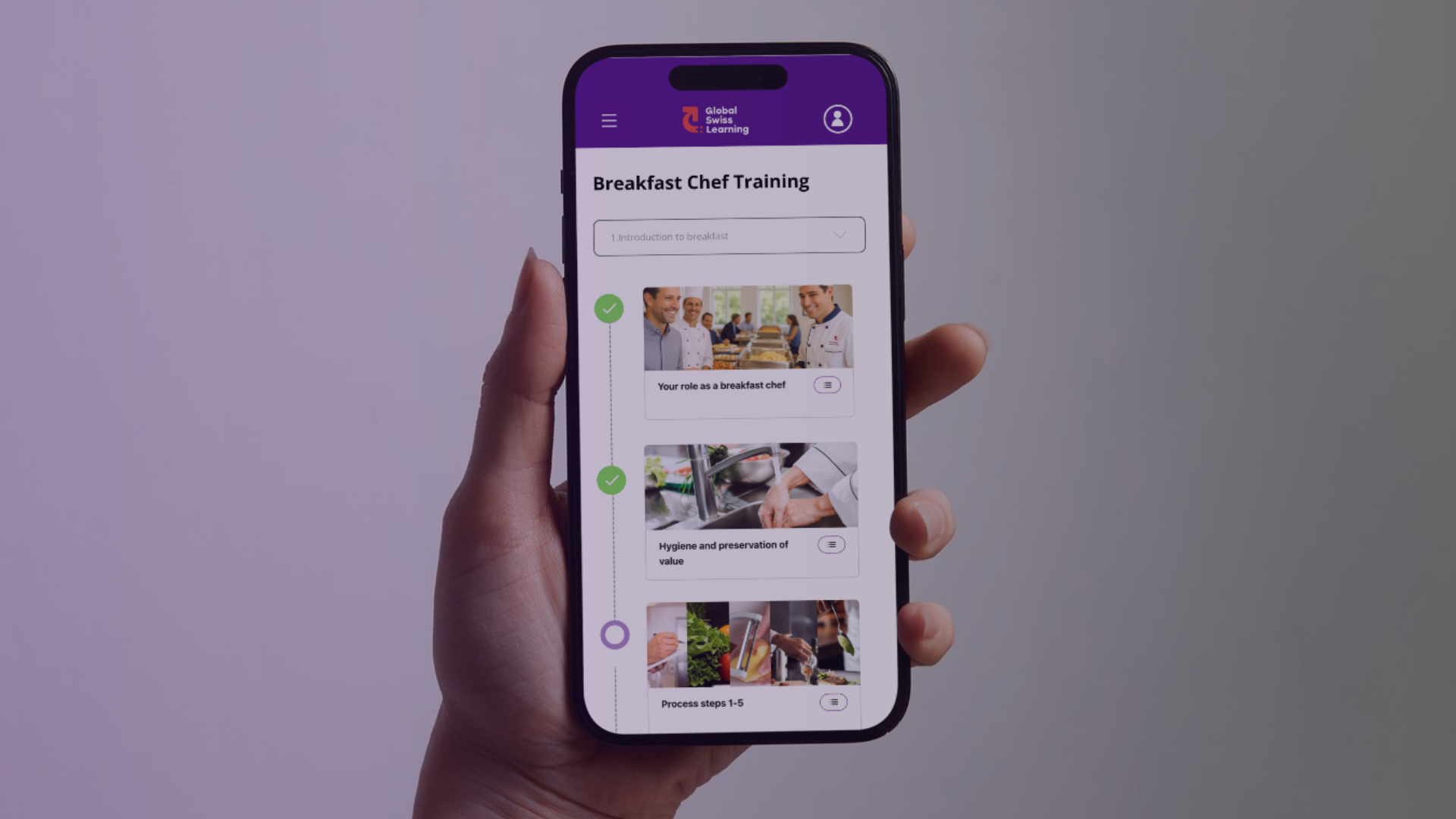
Global Swiss Learning implemented its digital Breakfast Chef Training, based on Swiss vocational education principles and focused on practical breakfast operations. The learning pathway covered:
🟣 Food safety and hygiene
🟣 Breakfast egg preparation
🟣 Dairy and fruit products
🟣 Nutrition principles
🟣 Herbs and spices
🟣 Sauces
🟣 Sustainability
🟣 Vegetables and potatoes
🟣 Breakfast buffet operations
🟣 Plating and presentation standards
Participants completed digital learning modules and knowledge assessments activities while applying their learning directly within their workplace. The self-guided format provided flexibility while maintaining a structured learning experience. The program was intentionally designed to fit within an 8-week learning journey, to allow chefs to balance operational responsibilities while completing meaningful professional development.
Results
The pilot delivered strong outcomes across learner satisfaction, confidence, workplace application, and knowledge acquisition.
Results at a glance
✅ Completed the learning program in 4-weeks
✅ 9-point increase in assessment scores (83% → 92%)
✅ 95% average final assessment score
✅ 100% recommendation rate
✅ 100% reported workplace application of learning
✅ Knowledge gains across all competency areas measured
Knowledge growth
Participants improved their average assessment scores from 83% before training to 92% after training, representing a 9-point increase in measured knowledge. The cohort achieved an average final assessment score of 95%. These results are particularly noteworthy given that participants entered the program with extensive professional experience and already strong baseline knowledge levels.
Confidence growth
Participants reported increased confidence across every competency area measured.
The largest improvements were reported in:
🟣 Operational guidelines and procedures
🟣 Breakfast-specific preparation techniques
🟣 Sustainable practices
🟣 Receiving and storing goods
🟣 Plating and presentation
The biggest improvement was observed in operational guidelines and protocols, demonstrating the value of structured training even for experienced hospitality professionals.
Learner satisfaction
The program achieved:
✅ 5.0 / 5 average course rating
✅ 100% recommendation rate
✅ 100% successful workplace application
Participants highlighted the practical nature of the training and its direct relevance to breakfast operations:
“The details and the training to have a running breakfast buffet in the best way possible.”
“It covers breakfast comprehensively.”
Strategic impact
One of the most important findings from the pilot was that measurable learning gains were achieved among experienced culinary professionals within a very short timeframe. Many hospitality training initiatives focus on onboarding or foundational skills. This pilot demonstrated that experienced chefs can also benefit from structured learning pathways that support continuous professional development, leadership readiness, and long-term career growth.
Perhaps most importantly, these outcomes were achieved in just four weeks. Participants improved assessment scores, and successfully applied their learning in daily operations while continuing to perform their regular responsibilities. The pilot demonstrated that self-guided digital learning can be a practical and effective scalable training model for culinary workforce development, even within busy hotel environments.
Workforce development focus areas
• Culinary workforce development
• Professional chef competencies
• Breakfast chef training
• Breakfast operations
• Self-guided digital learning
• Hospitality workforce development
• Swiss vocational culinary education
• Professional Culinary Development Pathways
• Leadership development
Looking to build chef development pathways at your organization?
👉 Discover our Breakfast Chef Training for professional chefs → Click here.
For related reading, explore our article on: Professional chef training: Building career pathways in hospitality