Challenges of consistency at scale
Imagine you are the Regional Operations Director for a hospitality group. Guest satisfaction scores are strong in some locations. In others, service feels inconsistent. You notice the following: at one property, new employees are fully confident within days. At another, managers spend weeks answering the same questions. Food safety procedures are followed rigorously in one kitchen, while another location has developed its own shortcuts.
When you look behind the scenes, you notice the training inconsistencies from one property to the next: One manager creates a presentation for onboarding. Another develops their own onboarding checklist. A third location relies primarily on shadowing and verbal instructions. Over time, multiple versions of the same training have emerged. The result? Employees performing the same role are often taught differently.
These inconsistencies don't develop intentionally, but instead because organizations grow faster than their training systems. Yet as organizations scale, training needs to become more centralized, not more fragmented.
Because guests don't care which manager trained the team or which country they're visiting. They're looking for the same quality, professionalism, and experience every time they walk through the door.
So, how can hotel and restaurant groups maintain consistency?
👇 Let’s dive into three large-scale best practices for standarizing training across mutiple locations:
────────
1. Define the standards that should never change
A hotel in Singapore and a hotel in Switzerland may serve different menus, operate under different regulations, and cater to different guest expectations. Local adaptation is necessary. Changing core operating standards is not.
The strongest hospitality organizations strike a balance between local flexibility and global consistency. They adapt what needs to change while protecting the standards that define their brand. Organizations that already prioritize structured onboarding often find it easier to maintain these standards as they grow. (You may also be interested in: How to Train New Hospitality Employees Faster Without Sacrificing Quality)
Best practices:
Identify which standards are non-negotiable across every location. These should be documented, accessible, and reinforced through training, onboarding, and performance reviews:
🟣 Food safety and hygiene
🟣 Service standards
🟣 Brand values
🟣 Operational procedures
🟣 Leadership expectations
These standards become the foundation of your training strategy and help ensure employees are aligned
2. Create a single source of truth for learning and development
For multi-location organizations, consistency starts with a shared learning environment. When employees access training through the same digital platform, organizations can ensure that everyone receives the same training content.
Whether employees are based in Zurich, Bangkok, Nairobi, or Dubai, they begin with the same foundation. This allows organizations to:
• Onboard employees faster
• Update standards globally
• Scale training efficiently
• Support multilingual teams
• Reduce training inconsistencies
• Provide on-demand access to learning
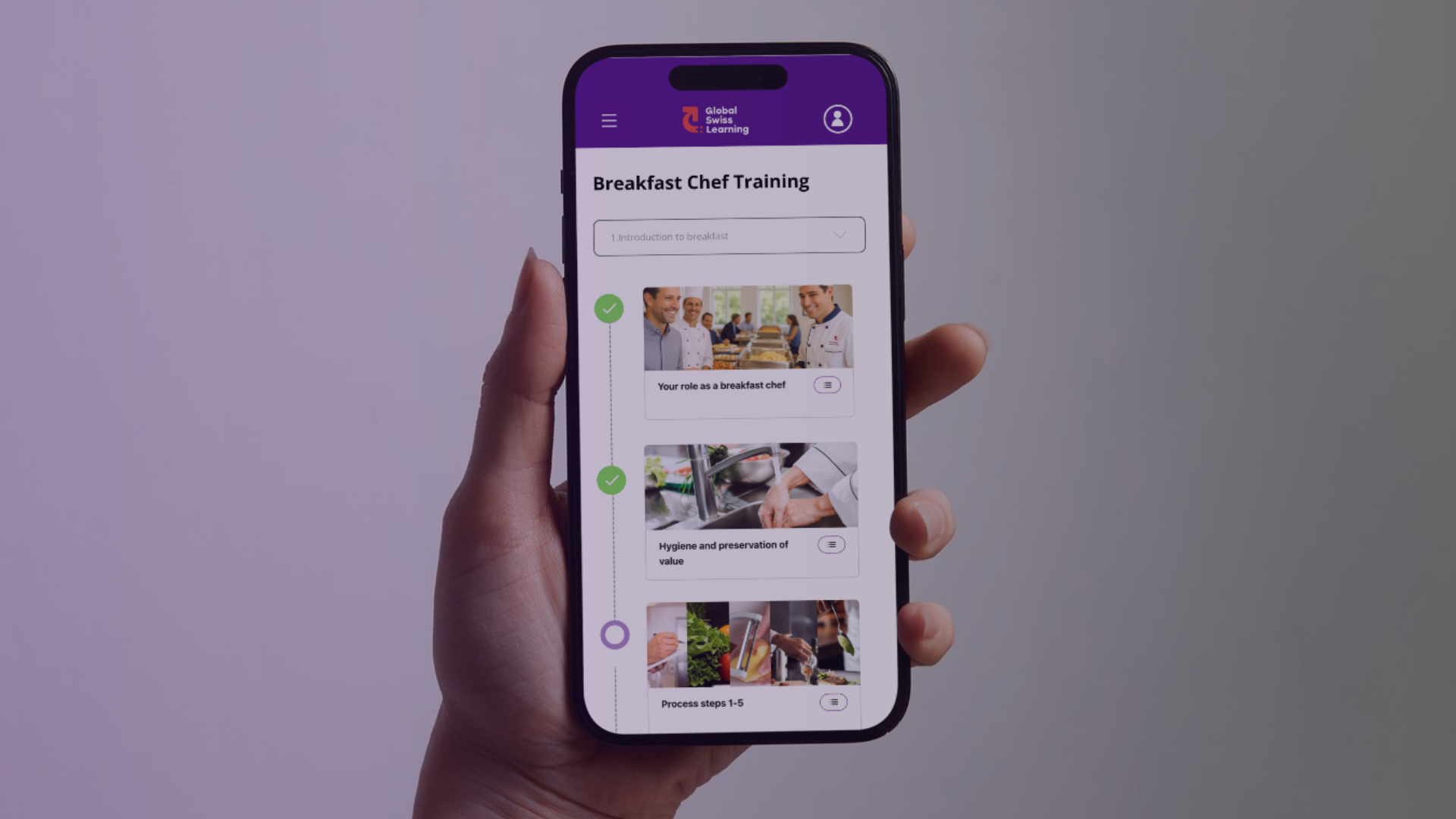
Most importantly, it creates a single source of truth for the entire organization, that can scale as the organization grows. At Global Swiss Learning, this is one of the reasons organizations use programs such as the Breakfast Chef Training and Kitchen Safety Training. By providing access to the same learning platform for their employees, businesses can deliver consistent training regardless of location.
Best practices:
🟣 Deliver all core training through one centralized platform, one learning ecosystem where employees access the same content, resources, and updates.
🟣 Avoid multiple versions of presentations, checklists, and training materials across locations.
(For organizations interested in how technology supports learning at scale, see our Swiss E-Learning powered by Swiss made software).
3. Verify skills through assessment and certification
How do you know employees can apply what they have learned? Certification programs and practical assessments provide evidence that skills and standards are being applied consistently across locations.
For hospitality employers, certification pathways bring consistency and transparency to workforce development. A chef, service professional, or trainer who demonstrates competency in one location can transfer to another property with greater confidence that expectations remain aligned.
This is particularly valuable for international hospitality groups looking to develop internal talent and support workforce mobility. Organizations investing in our blended learning Train-the-Trainer programs create internal champions who can reinforce standards locally while following a globally aligned framework.
Best practices:
🟣 Measure competency, not course completion. Completing training does not guarantee consistent performance.
🟣 Establish clear competency benchmarks and use assessments, observations, or certifications to verify that employees can apply standards in practice.
🟣 Focus on three questions: Can employees consistently demonstrate the required skills? Are competencies assessed using the same criteria across locations? Is there a clear pathway for employee development and progression?
When employees are measured against the same standards, organizations gain confidence that quality is being maintained regardless of location.
────────
Consistency creates growth opportunities
One of the most overlooked benefits of standardized training is that it supports growth:
• Opening a new property becomes easier when onboarding, training materials, and assessments are already in place.
• Promoting employees becomes easier when competencies are measured consistently.
• Expanding into new markets becomes easier when the organization's standards are already clearly defined.
As global hospitality businesses continue to grow, industry organizations such as UN Tourism have emphasized the importance of workforce development and skills training in supporting sustainable industry growth. In this way, training becomes much more than an HR initiative. It becomes part of the organization's growth strategy.
Organizations that combine structured learning with employee engagement strategies often see stronger adoption and longer-term success.(See: Gamification ups motivation at Swiss restaurant group.) Similarly, businesses investing in long-term workforce development frequently experience wider organizational benefits, including stronger retention and career progression opportunities.(See: In-house education: The key to employee retention at Lenkerhof).
Bringing it all together
Guests expect consistency, even when locations operate in different countries, cultures, and environments. They expect the same quality, professionalism, and attention to detail every time they interact with your brand. The challenge is not eliminating local flexibility. The challenge is ensuring that every employee understands the standards that define your organization.
Hospitality groups that combine clear expectations, digital learning, and competency-based certifications are better positioned to maintain quality at scale, support employee development, and deliver a consistent guest experience across every location. This approach mirrors a wider shift across hospitality and vocational education toward measurable skills development, standardized competencies, and lifelong learning.
Whether that means standardizing food safety training, rolling out a global Chef Training program, or developing internal trainers through a Train-the-Trainer certification, the principle remains the same: Guests experience your standards. Training is how you deliver them.
Looking to standardize training across multiple locations?