What types of hospitality training and education solutions are out there?
Professional chef training providers often fall into one of five different categories:
🟢 Online learning platforms, which provide flexible digital learning resources and short-format content.
🟡 Training providers, which deliver structured learning programs, assessments, and guided development pathways designed to build practical skills and improve workplace performance.
🟠 Certification bodies, which define professional standards and assessment frameworks and often also provide internationally recognized certification.
🟣 Workforce development partners, which help employers develop talent, strengthen onboarding, build internal training capability, and support career progression.
🔵 Hospitality schools, which focus on formal education and qualifications.
These categories provide a useful starting point in this comparison guide, and yet are not always clear-cut. As market needs evolve, providers may combine multiple elements in their approach. What is important is that each plays an important role within the industry. To choose the right training and education, look closely at how a provider bridges the gap between education, skills development, and operational performance and consider what your hospitality organization wants to prioritize when investing in chef development:
🟣 Practical workplace application
🟣 Industry relevance
🟣 Scalability across multiple locations
🟣 Career progression pathways
🟣 Trainer quality and instructional framework
🟣 Digital accessibility
🟣 Assessment and certification standards
🟣 Train-the-trainer capabilities
🟣 Alignment with organizational goals
Often the most effective solutions deliver world-class content and certification, and help organizations build capability. For a more in-depth understanding of what your organization might need, see: How to Choose the Right Professional Chef Training for Your Hospitality Team.
👇 Now that we’ve summarized what kind of providers are out there, let’s dive into the range of options, including hospitality schools, online providers, industry associations, and workforce development partners.
────────
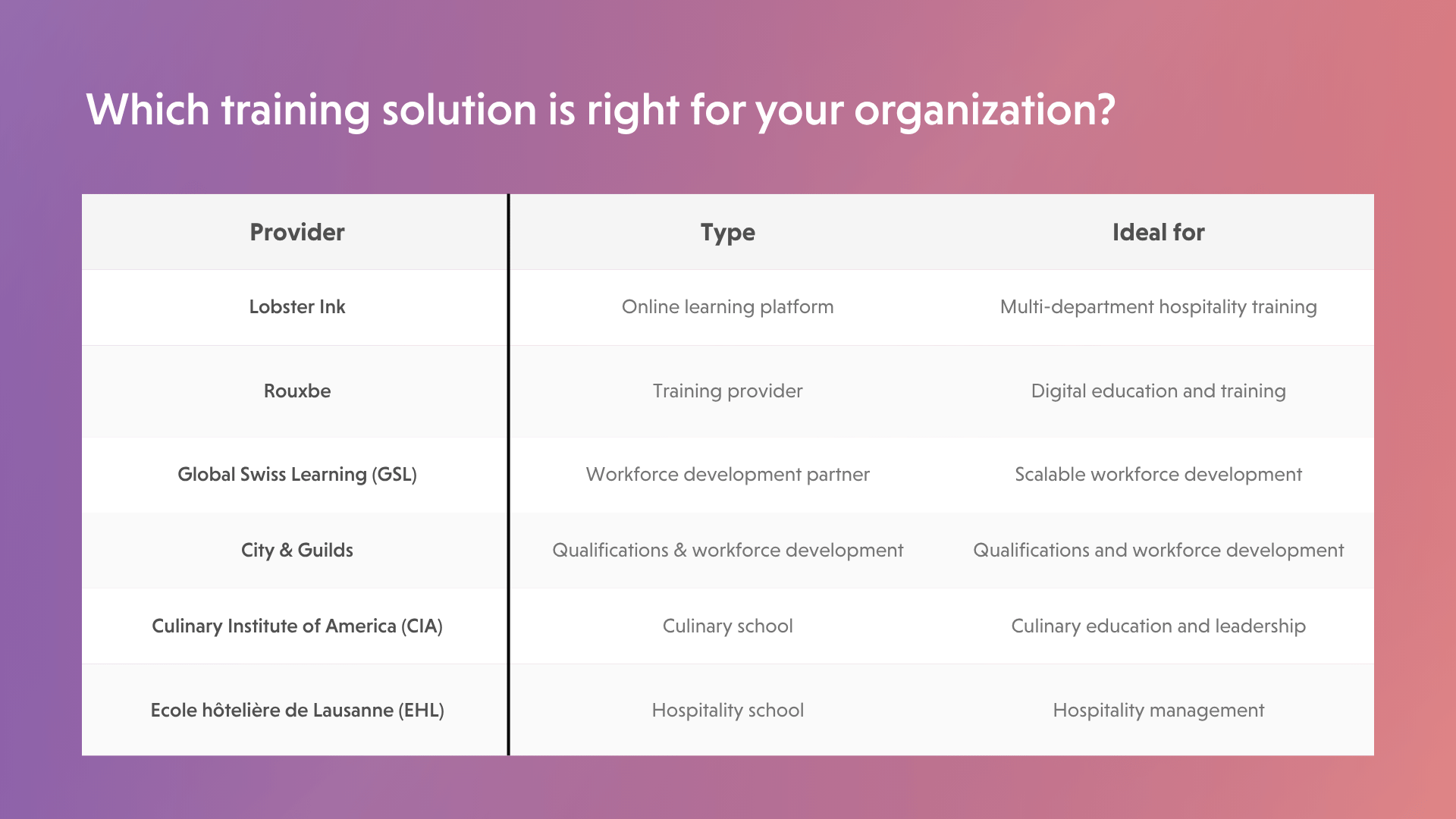
1. Lobster Ink
🟢 Type of provider: Online learning platform
Overview
• Online hospitality microlearnings
• Large hosptiality training library
• Large culinary course library
• Chef professional pathways (with CIA)
• Luxury hospitality expertise
• Multilingual content
• Strong visual learning experiences
Best for
• Hotel groups
• Luxury hospitality brands
• Multi-department workforce training
Why organizations choose Lobster Ink: Lobster Ink (Ecolab) is well known for hospitality operations training and has strong adoption among luxury hospitality organizations. Their chef professional pathways, ProChef® and Plant Forward Kitchen, are approved by the World Chefs Association (WACS), and can provide more structured development journeys for culinary professionals in addition to their culinary microlearnings.
Their content extends beyond culinary topics into broader hospitality operations, making it attractive for companies looking to train multiple employee groups within a single platform.
Ideal when: Online hospitality-wide operational training is your priority.
────────
2. Rouxbe
🟡 Type of provider: Training provider
Overview
•Online culinary school
• Large culinary-specific training library
• Self-paced learning
• In-person instruction available
• Industry-recognized certifications, including from WACS
• Multilingual content
• Role-based learning
• Career development frameworks
• Large-scale enterprise deployment capabilities
Best for
• Individual learners
• Culinary schools
• Hospitality organizations
Why organizations choose Rouxbe: Rouxbe is a well know training partner, and a pioneer in online culinary education. They offer a broad catalogue of culinary courses covering cooking techniques, nutrition, food safety, and professional skills. Their platform is particularly effective for organizations seeking flexible digital learning solutions. With new flexibility to combine online learning and practical skills development with in-person Rouxbe instructors, they’ve started to grow their workforce development offerings.
Ideal when: Digital-first culinary education and career development is your priority.
────────
3. Global Swiss Learning (GSL)
🟣 Type of provider: Workforce development partner
Overview
• Swiss vocational education expertise
• Digital and self-paced learning delivery
• Online learning platform
• Large culinary-specific training library
• Professional chef training pathways
• Career development frameworks
• Hospitality trainings
• Multilingual content
• Corporate train-the-trainer programs
• Large-scale enterprise deployment capabilities
• Swiss industry certifications from the Swiss Chefs Association
• Abilitiy to produce / customize training content
Best for
• Hospitality groups
• Hotels, restaurants and catering organizations
• Multisite operators
• Private and charity culinary schools
• Workforce development projects
Why organizations choose Global Swiss Learning: Global Swiss Learning’s Swiss vocational trainings are internationally recognized for combining structured learning with workplace application, helping employers develop skills that can be consistently transferred across teams. In addition to technical culinary knowledge, they emphasize competency development, assessment, long-term career progression, and building internal training capability within organizations. This approach supports organizations looking to combine technical skills development with long-term workforce capability building. Their growing availability of online-only courses indicate they’ve started to grow their training partner capabilities.
Ideal when: Building a skilled, consistent, and scalable culinary workforce is your strategic priority.
4. City & Guilds
🟠 Type of provider: Qualifications and workforce development
Overview
• Globally recognized qualifications and framework
• Network of connected training centers
• Vocational education expertise
• Digital learning resources
• Career development frameworks
• Apprenticeships
• Internally developed trainings
Best for
• Training institutions
• Workforce development initiatives
• Certification-focused environments
Why organizations choose City & Guilds: City & Guilds has extensive experience in skills assessment and vocational qualifications across multiple industries, including hospitality. They offer qualifications through approved centres, employer partnerships, apprenticeships, and employer-developed training frameworks, which hospitality organizations can engage with more directly as part of workforce development initiatives. Organizations often choose City & Guilds when formal qualifications, workforce development frameworks, and standardized assessment are important.
Ideal when: Formal qualifications and assessment are additional key priorities.
────────
5. Culinary Institute of America (CIA)
🔵 Type of provider: Culinary school
Overview
• Global industry reputation
• Undergraduate and graduate culinary degrees
• Professional chef certification pathways
• Online and in-person programs
• Strong alumni network
• Advanced culinary expertise
Best for
• Individual professionals
• Working professionals
• Executive development
• Culinary leadership development
• Advanced professional education
• Organizations investing in high-potential culinary talent
Why organizations choose CIA: The Culinary Institute of America (CIA) is one of the world's most recognized culinary education institutions. In addition to degree programs, it offers professional development and executive education designed to help culinary professionals strengthen both technical expertise and leadership capabilities. Its industry reputation, alumni network, and focus on culinary excellence make it a popular choice for chefs pursuing advanced professional development. Their growing availability of online-only courses, in collaboration with online providers like Lobster Ink, indicate they’ve started to grow their training partner capabilities.
Ideal when: Prestige, advanced culinary expertise, and leadership development are your priorities.
────────
6. Ecole hôtelière de Lausanne (EHL)
🔵 Type of provider: Hospitality school
Overview
• Global hospitality education reputation
• Swiss educational heritage
• Undergraduate culinary degree
• Graduate degree in hospitality management
• Additional culinary certificates and courses
• Trainer development programs
• Leadership and executive education offerings
• Advanced hospitality and culinary expertise
Best for
• Individual professionals
• Future hospitality leaders
• Management development
• Executive education
Why Organizations Choose EHL: EHL is internationally recognized for hospitality education, leadership development, and Swiss hospitality excellence. Beyond culinary training, their programs help professionals develop management, operational, and leadership capabilities that support long-term career progression within the hospitality industry. Their blend of hospitality expertise, executive education, and global industry reputation makes them attractive to organizations investing in future leaders. Their additional culinary certificates and courses indicate they're adapting to market needs of shorter length programs and online education and training.
Ideal when: Hospitality leadership, management capability, and long-term career progression are your priorities.
────────
How to compare professional chef training providers
As you evaluate potential providers for your organization, consider these questions:
1. Can the training scale? Many programs work well for individuals but become difficult to manage across multiple properties or regions.
2. Is learning applied in the workplace? The strongest programs connect learning directly to operational performance rather than focusing solely on theoretical knowledge.
3. Does the provider support career pathways? Organizations increasingly use training as part of talent retention and succession planning.
4. Are trainers developed as well as learners? Programs that include train-the-trainer capabilities can help organizations build internal expertise and reduce reliance on external instructors.
5. Does the framework align with hospitality operations? Hospitality organizations require practical, measurable skills that translate into workplace performance.
────────
Putting chef development into practice
There is no single "best" professional chef training provider for every organization. For hospitality employers, the key question is not which provider offers the most courses or certifications. It is which solution best supports the skills, career progression, and operational outcomes your organization is trying to achieve.
For some organizations, the priority may be leadership development, giving employees access to a career achievement, one that provides knowledge and international recognition. For others, it may be workforce development, operational consistency, digital delivery, or internal career progression. By focusing on the broader impact of training, hospitality leaders can build stronger culinary teams and create long-term value for both employees and guests.
Looking for the right approach to chef development, workforce training, or culinary certification?
Explore how Global Swiss Learning helps hospitality organizations build skills, career pathways, and internal training capability through Swiss-inspired vocational education and workforce development solutions.
👉 Explore our solutions for hospitality organizations
👉 Discover our profressional chef trainings
Note: Global Swiss Learning is a provider of professional hospitality training and workforce development solutions. This article reflects our perspective on factors organizations may wish to consider when evaluating training options. The providers featured are intended to represent a range of approaches to hospitality education, training, and workforce development rather than an exhaustive list. Many other organizations may offer relevant programs, services, or certifications depending on your industry, location, and learning objectives.