Why certification alone isn't enough
A certificate can demonstrate that learning has taken place, but it does not automatically translate into improved workplace performance. For hospitality organizations, the value of training should be measured by outcomes—like more consistent food quality, faster onboarding of new team members and improved kitchen safety and hygiene.
Given the challengess hospitality teams are facing—skills shortages, high turnover, inconsistent execution and multi-site operations—professional chef training should support larger goals, like reducing supervisory burdens on senior chefs, increasing employee engagement and retention, and creating stronger internal promotion pathways. For decision-makers, this means looking beyond the certificate itself to consider how effectively the program supports your organization's goals.
👇 To identify a solution that delivers lasting value, hospitality leaders can use the following checklist to evaluate their next learning provider:
────────
1. Look for training that reflects real kitchen operations
Many culinary programs focus heavily on theory or techniques taught in isolation. While technical knowledge remains important, hospitality employers benefit most from training that is directly connected to day-to-day kitchen operations.
Consider whether the training includes:
🟣 An overview of process steps (from planning to presentation)
🟣 Mise en place and workstation management
🟣 Food safety and hygiene
🟣 Production planning
🟣 Receiving and storage (quality standards)
🟣 Waste reduction
🟣 Teamwork and communication
The closer the learning experience is to the realities chefs are facing in a professional kitchen, the more likely it is to drive measurable performance improvements.
2. Evaluate whether the training supports career development
Executive chefs and HR leaders are increasingly viewing training as a talent development tool rather than a compliance exercise. The strongest programs will also provide structured progression pathways that allow employees to continue developing their skills over time (ideally in addition to bite-sized learnings, which are essential to balancing time constraints).
Questions to ask include:
🟣 Does the training support different experience levels?
🟣 Is there a pathway from entry-level roles to more advanced positions?
🟣 Can the program be integrated into talent development plans?
🟣 Does it support succession planning within the kitchen brigade?
Employees are more likely to remain engaged when training is connected to long-term growth opportunities rather than a one-time certification.
3. Consider how easily the training can scale
Training that works for one property may not work across ten properties. For multi-site operators, hotel groups, and hospitality brands, scalability is a critical consideration. Scalability can be measured by different metrics, depending on the property. Look for programs that offer:
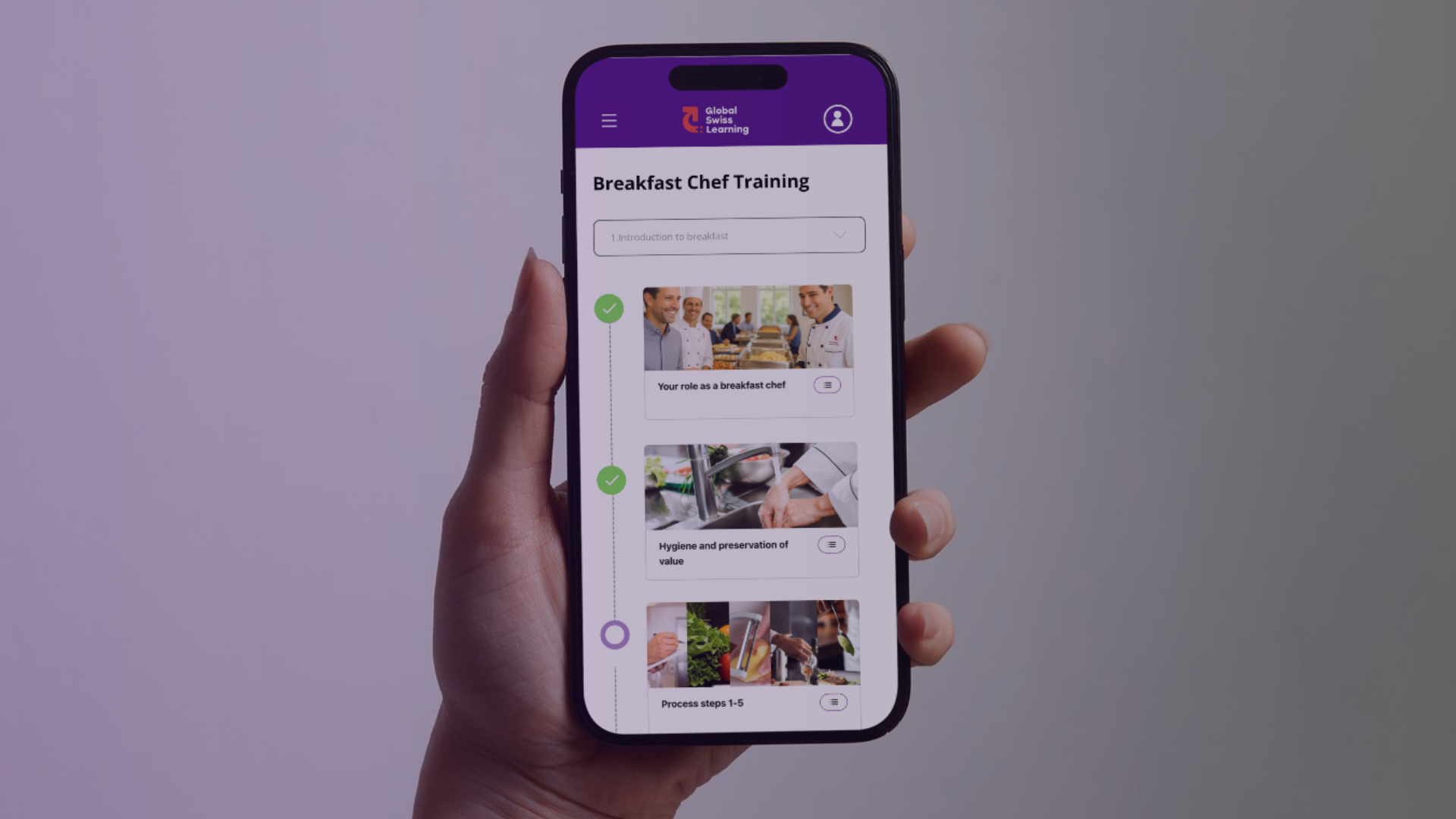
🟣 An accessible digital learning platform
🟣 Flexible implementation
🟣 Onboarding and continued support from the provider
🟣 Progress tracking and reporting
🟣 Multilingual delivery where required
The ability to deliver consistent education and training across geographically dispersed teams can significantly improve operational alignment.
4. Prioritize practical application
One of the most common challenges in workplace learning is the gap between learning and implementation. The most effective chef training programs will engage learners, and encourage them to crosslink theoretical and practical knowledge. That is, to directly apply what they've learned in their workplace.
Indicators of strong practical relevance include:
🟣 Workplace cooking and recipe assignments
🟣 Demonstration and assessment of skills
🟣 Real-world kitchen scenarios
🟣 Manager involvement
🟣 Opportunities for coaching and feedback
A professional training should help chefs perform better in their roles overall, not simply prepare them to pass an assessment.
5. Assess the quality of the content and learning framework
Not all chef training is built around the same educational standards. Look for educational frameworks that have an international reputation for high-quality vocational education and workforce development. Those that combine practical workplace experience with structured learning are frequently cited as a benchmark for preparing skilled professionals across industries. When it comes to comparing providers, consider:
🟣 Credibility of the training methodology
🟣 Industry relevance of the content
🟣 Alignment with recognized hospitality standards
🟣 Learning design and structure
🟣 Assessment methods
Both course content and learning framework should be designed to support long-term competency development, practical application in the workplace, clear progression pathways, and measurable standards. This will create greater consistency and a more reliable learning experience for employees and employers.
6. Don't overlook internal capability building
Some organizations focus exclusively on training individual chefs. However, leading hospitality employers are increasingly investing in developing training capacity within their organization, without needed to rely on external providers. This is achieved by creating a network of internal trainers, mentors, and kitchen leaders.
A train-the-trainer approach helps organizations:
🟣 Maintain standards over time
🟣 Reduce reliance on external training
🟣 Support onboarding
🟣 Strengthen knowledge transfer
🟣 Develop future leaders
The long-term value of education and training comes not just from developing chefs, but from building a culture of continuous learning at your organization.
7. Focus on business impact
Before selecting a training provider, establish what success looks like for your organization. This will depend on your organization's long-term and short-term goals, and areas in which you're trying to improve. Examples of some common return on investment (ROI) metrics used by organizations may include:
🟣 Faster onboarding times
🟣 Improved guest satisfaction
🟣 Reduced food waste
🟣 Higher compliance scores
🟣 Internal promotions
🟣 Improved retention
The most effective training investments are those that contribute to these larger organizational objectives.
8. Ask yourself these questions, before choosing your chef training provider
Before making a decision, hospitality leaders should ask themselves:
🟣 How does this training improve workplace performance?
🟣 What practical skills will employees develop?
🟣 How will learning be applied on the job?
🟣 Can the program scale across multiple properties?
🟣 Does it support career progression?
🟣 How is learner progress measured?
🟣 What long-term impact has the provider delivered for other hospitality organizations?
The answers often reveal far more than a course syllabus or certificate description.
────────
Looking ahead: what brings growth?
Certification remains an important part of professional development, but it isn't a metric for business growth, and shouldn't be the primary factor when evaluating your next educational provider for professional chef training. The best professional chef training programs help hospitality organizations build skills, strengthen standards, support career growth, and improve operational performance. These outcomes are not arbitrary. The opposite, they help increase business outcomes.
For executive chefs, HR teams, learning and development managers, and general managers, the goal is not simply to train chefs: It's to create capable, confident teams that can consistently deliver high-quality guest experiences that allow hospitality businesses to grow.
Looking to strengthen culinary skills, standardize training, or develop future kitchen leaders?
👉 Explore Global Swiss Learning's professional chef training solutions for hospitality organizations.
👉 Discover our professional chef training courses for culinary professionals